

Soil Bearing Capacity
Soil bearing capacity refers to the capability of soil to withstand vertical or lateral loads applied to the ground above. The value of this capacity varies for different types of soils based on their densities, shear strengths, types, and the embedment depth of the load. Soil bearing capacity can be enhanced by constructing reinforced concrete foundations that help efficiently distribute the load over a larger area.
It is important to determine the soil’s bearing capacity before building any foundation or using any equipment on the ground to withstand the load efficiently without any failure or settlement risk. This ensures the successful and effective completion of any construction project and the security of newly built structures.
This article helps you learn about the significance of determining soil’s bearing capacity, its types and formulae, and the different tests used to determine this value. It also includes a step-by-step procedure to calculate the bearing capacity of soil and different methods to enhance the soil’s bearing capacity. You can also know the bearing capacity of different types of soils.
Significance of Determining Soil Bearing Capacity
Determining the soil’s bearing capacity is one of the significant engineering factors that helps ensure the safety of bridges, buildings, roads, and other structures and prolong their lifespan. Engineers investigate the bearing capacity of soil to design foundations and add the required supporting structures for effective load distribution and prevention of soil shifting.
It is crucial to determine the value of the soil’s bearing capacity when working in areas where weak soil conditions persist, or the soil is susceptible to seismic activities. This value then helps the engineers in implementing the required techniques to improve the soil conditions and enhance the soil’s bearing capacity to ensure the reliability and safety of the structures being built. It saves the structures from the risk of failure and protects your investment.
Types & Formulae for Soil Bearing Capacity
Ultimate Bearing Capacity of Soil (qu)
It refers to the maximum amount of vertical weight that a particular type of soil can sustain without getting settled down or sheared apart under the structure that has already been constructed over the ground.
Allowable/Safe Bearing Capacity of Soil (qs)
The allowable or safe bearing capacity of soil is the maximum amount of force that soil can bear without surpassing the allowable settlement limit.
Net Ultimate Bearing Capacity (qnu)
The value of net ultimate bearing capacity is obtained by multiplying the soil’s weight (𝝲) with the foundation’s depth (D) and subtracting the value from ultimate bearing capacity (qu) as:
qnu = qu – 𝝲 D
Net Safe Bearing Capacity (qns)
The net safe bearing capacity (qns) can be calculated by dividing the net ultimate bearing capacity (qnu) by a factor of safety (F) as:
qns = qnu / F
Gross Safe Bearing Capacity (qs)
The gross safe bearing capacity (qs) of the soil can be calculated by dividing the ultimate bearing capacity (qu) by a factor of safety as:
qs = qu / F
Net Safe Settlement Pressure (qnp)
It is the maximum load that the soil can withstand before it surpasses the allowable amount of soil settlement.
Net Allowable Bearing Capacity (qna)
It is one of the most crucial values for the foundation’s design and is equal to the net safe bearing capacity (qns) or the net settlement pressure (qnp), whichever has a lower value.
Different Tests to Determine the Soil Bearing Capacity
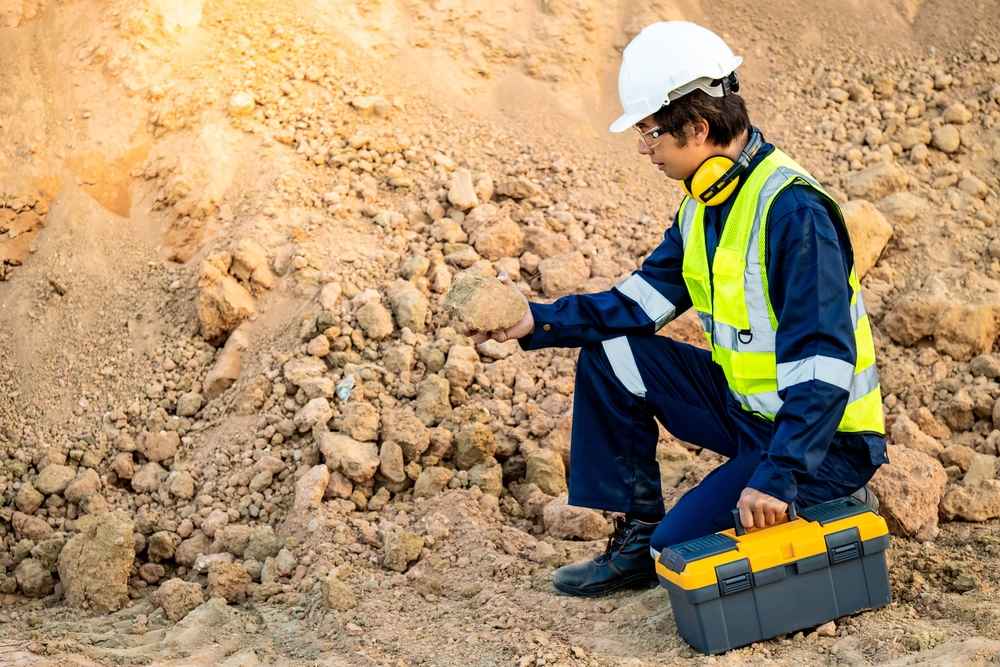
There are different testing methods to check the bearing capacity based on varying testing conditions and the type of soil. The following are some of the testing methods used for this purpose:
CPT (Cone Penetration Test)
In this technique, a cone-tipped probe is used for driving into the soil to record the cone resistance and sleeve friction as the depth increases. The recorded measurements are then used for calculating the bearing capacity.
Plate Bearing Test
This test is conducted at the construction test and involves the application of load onto a test plate to measure the induced settlement as a result. The obtained data is used for deriving load-settlement curves which helps in calculating the bearing capacity of soil.
Pressuremeter Test
This test is carried out in-situ for measuring the deformability and strength of soil by inflating a cylindrical probe within a borehole. The changes in pressure and volume are continuously monitored and the recorded results are then interpreted for deriving soil characteristics, such as bearing capacity and shear modulus.
SPT (Standard Penetration Test)
This testing method is helpful in determining the bearing capacity of cohesionless soil. It involves measuring the penetration resistance when a standard sampler is driven into the soil by applying a standard amount of energy with a drop hammer. The number of blows needed to drive the sampler for the last third of the total penetration depth of 12 inches gives the SPT value for estimating the bearing capacity of the soil.
Procedure to Calculate Soil Bearing Capacity
Calculating the soil’s bearing capacity is crucial before designing and constructing bridges, buildings, roads, or other structures. It helps to ensure how much load a ground can safely withstand and also prevents the risk of potential failures at any stage. The following are the essential steps to calculate soil’s bearing capacity:
- Determine the nature of the site by exploring the construction site.
- Perform SPT (Standards Penetration Test) and CPT (Cone Penetration Test) to select the most suitable method for determining the bearing capacity of soil.
- Classify the soil depending on its grain size, mineralogy, and structure according to the standards of USCS (Unified Soil Classification System) and AASHTO (American Association of State Highway and Transportation Officials)
- Calculate various soil parameters, including bulk density, cohesion, internal friction angle, and unit weight, with the help of CPT or SPT data.
- Choose the relevant bearing capacity formula.
- Substitute the soil parameters in the chosen formula and solve them to get the soil’s ultimate bearing capacity value.

Methods to Enhance Soil’s Bearing Capacity
The following are some of the methods which help in enhancing the overall soil’s bearing capacity:
Compaction: Compaction of soil brings all the particles together, making them less susceptible to movements which lead to improve the bearing capacity of soil.
Base Width’s Increase: The width of foundations can be increased up to a certain limit which helps in reducing the amount of pressure and increasing the soil’s bearing capacity.
Soil Drainage: Proper and efficiently working drains in the foundation channels for eliminating excess water and increasing the carrying capacity of sandy soils in grounds with high water tables.
Deep Foundations: Constructing deep foundations help in transferring the load to underlying strata and this method can be conveniently used for grounds where subsurface material moisture is not an issue.
Soil Constraining: The soil can be constrained by enclosing the ground with sheet piles installed, which help stop soil movements, create an enclosure, and increase the bearing capacity of the soil.
Grout Application: A suitable number of borings can be made into the soil, forcing the concrete grout into the foundations for filling up the cracks and crevices, making the soil capable of supporting enough weight.
Soil Replacement: If the soil has deteriorated significantly, it is suggested that it be replaced. This can be done by removing and excavating the soil’s upper layer and adding any hard material, such as gravel, sand, stones, etc.
Safe Bearing Capacity of Various Soils
Below is the soil bearing capacity table kn/m2:
|
No. |
Soil Type |
Safe Bearing Capacity in kN/m2 |
|
Cohesive Soils |
||
|
1. |
Soft Clay |
150 |
|
2. |
Very Soft Clay |
50 |
|
3. |
Medium Clay |
245 |
|
4. |
Sand Clay & Moist Clay |
150 |
|
5. |
Black Cotton Soil |
160 |
|
6. |
Stiff or Rigid Clay in a Deep Bed |
440 |
|
Cohesionless Soil |
||
|
7. |
Sandy Gravel |
245 |
|
8. |
Fine Sand & Silt |
150 |
|
9. |
Dry & Loose Sand |
100 |
|
10. |
Dry & Compact Sand |
440 |
|
|
Gravel & Sand Mixture |
440 |
|
11. |
Dry and loose sand |
100 |
|
Rocks |
||
|
13. |
Soft Rocks |
440 |
|
14. |
Hard Rocks |
3240 |
|
15. |
Laminated Rocks |
1620 |
|
16. |
Broken & Shattered Bedrock & Hard Shale |
880 |
Table of Contents